Team-building games for companies, organizations, and teams
When you look for team-building games, it’s rarely "just for a good feeling." Usually, there’s a specific reason: A new team needs to come together faster, interfaces are strained – or you work solidly but more side-by-side than together.
Good team-building games aren’t magic tricks. But they make collaboration visible: communication, roles, responsibility, and decision paths become tangible. And that’s exactly what ensures teams work better afterward – not just get along nicer.
What you take away from the article:
- Which team-building games really work for which goals
- Concrete processes (duration, materials, moderation) – no fluff
- Games for communication, decisions, interfaces & trust – including pro tools
Table of contents
How to choose the right team-building game
So that a "game" becomes a real team impulse – without awkward side programs.
The most common mistake: Games are chosen too generally. "It's fun" rarely suffices in a business context. Instead, ask a clear question:
What should your team be able to do better after the game than before?
Classic team-building games
Action & collaboration – roles, communication, and responsibility become visible.
1) Raft building challenge
Roles, decisions, dealing with setbacks
60–180 minutes (outdoor)
New teams, project starts
Process: Materials (wood, ropes, barrels) + task: Build a load-bearing raft – without instructions. Planning, building, and testing are up to the team.
Evaluation: How were decisions made: plan first or act immediately? Who coordinates, who listens?
2) Rope bridge construction
Responsibility, safety, reliability
60–120 minutes
Leadership, responsibility topics
Process: The team plans and constructs a load-bearing rope structure that is eventually walked on. Uncertain agreements become immediately visible.
Evaluation: What was “courage” – and what was “uncertainty”? Where was responsibility truly taken?
3) Marble run in a team
Interfaces, handovers, coordination
30–60 minutes
Project teams, processes, departmental work
Procedure: Subgroups build individual sections. The marble must not be stopped or touched. Only if all handovers work does it reach the goal.
Evaluation: Where did “my task” end – and where did real collaboration begin?
4) Spaghetti tower (Marshmallow challenge)
Iterating, dealing with mistakes, pace
20–45 minutes
Innovation & project teams
Procedure: Build a tower from spaghetti, tape, and string that supports a defined load (e.g., marshmallow). Time limit creates dynamics.
Evaluation: Planner vs. doer: What worked better – and why?
5) Ball transport with half pipes
Attention, nonverbal coordination
10–25 minutes
Activation, short formats
Procedure: A ball must be transported together over a distance without touching it with hands. Speed, distance, and movement must be synchronized. The Teambahn set already includes everything – you can start right away!
Evaluation: Who “led” or “pulled along” the team? What was the smallest common rhythm?
6) Fröbel Tower under time pressure
Communication, leadership, coordination
15–45 minutes
Project teams, leadership, coordination
Procedure: 2 minutes planning phase (no touching), then 6 minutes building time with stopwatch. Afterwards reflection: Who leads? Who mediates? Which rule was missing?
Tool: Fröbel Tower – team game for communication, leadership & coordination
Communication & cooperation games
If you want to reduce misunderstandings and get “on the same page” faster.
7) Square Up (collaborate without words)
Nonverbal coordination, attention, patience
10–30 minutes
Team days, conflict prevention, quiet/dominant teams
Procedure: A common goal, no language. This is exactly how patterns become visible: dominance, withdrawal, oversteering, waiting.
8) Feel & Find (training precise communication)
Describing, questioning, listening
15–45 minutes
Interfaces, onboarding, communication training
Process: One person describes, others must recognize/assign based on the description. Misunderstandings become visible – without it becoming personal.
Tool: Feel & Find – communication game for precise description
9) Deep Zoom Challenge (reconstructing the big picture together)
Active listening, structuring, perspective change
20–60 minutes
Project teams, complex tasks, training
Process: Each person sees only part of a sequence of images. The team must create the correct order through precise description and questioning.
Tool: Deep Zoom Challenge – team-building game for listening & structure
10) Gyroscope drawer (making coordination & roles visible)
Coordination, patience, team roles
10–35 minutes
Warm-up, team development, workshops
Process: Several people jointly control a pen via strings. The goal is a precise drawing, such as "tracing" a labyrinth. Team patterns become immediately visible.
Tool: Gyroscope drawer – drawing as a team (cooperation & communication)
11) Magic wand (Helium Stick effect)
Rules, shared control, clarity
10–25 minutes
Communication, self-organization
Process: Everyone touches the stick only with their index fingers. Goal: lower it in a controlled way without losing contact. Sounds easy – often surprisingly hard.
Tool: Magic wand – cooperation game (Helium Stick) for clear agreements
Decision & prioritization games
When discussions are tough and responsibility remains "diffuse."
12) Survival scenario
Argumentation, consensus, group dynamics
20–45 minutes
Decision processes, team alignment
Process: The team prioritizes items based on a scenario (e.g., plane crash). The goal is not "right," but "jointly viable."
Evaluation: Whose arguments prevail – and why?
13) Resource allocation game (concrete scenario)
Priorities, trade-offs, shared responsibility
30–75 minutes
Strategy, planning, leadership teams
Process: For example, there is a €100,000 budget, but three initiatives compete: digitization, personnel development, growth/marketing. Every decision means giving something up.
Evaluation: Which criteria were truly decisive – and which were just "arguments"?
14) Joint rule development (Team Operating System)
Commitment, less friction
45–90 minutes
Fresh starts, growth, new structures
Process: The team defines 5–8 rules that are testable (“How do we notice it?”). Then select 1 rule and try it out for 14 days.
Evaluation: Which rule immediately reduces friction – without bureaucracy?
15) Decision Dilemma with Estimation Questions
Consensus, dealing with uncertainty
15–35 minutes
Teams with “discussion overkill”
Process: The team must agree on one answer – without a perfect solution.
- How many screws are in this jar?
- How many inhabitants does city X have?
- How many emails does the team receive per week (on average)?
16) Team Puzzle (Perspective Shift That Really Works)
Question assumptions, perspective shift
20–60 minutes
Interfaces, change, departmental work
Important: This game does not work with just any puzzle. The learning effect arises because key pieces only fit when turned counterintuitively. Intuition leads to a dead end – the team must rethink.
Tool: Team Puzzle – Experience a perspective shift within the team
17) Decision Matrix
Transparency, clarity, less politics
30–90 minutes
Roadmaps, Prioritization, Decisions
Process: Options + criteria (impact, effort, risk, time) are weighted and evaluated together. Result: a comprehensible decision.
Meaning- & Purpose-oriented Team Formats
When teams need motivation, culture, or a clear “why.”
18) Charity Challenge
Process: The team plans and carries out a joint action for a good cause. Focus: collaboration, not competition.
Suitable for: Team days, values work, culture development
19) Building for Others
Process: The team builds/creates something that is consciously passed on. Result-oriented, meaningful, connecting.
Suitable for: Purpose formats, educational/social contexts
20) Donation Decision Process
Process: The team jointly decides where money/time/resources go. Values become concrete – not just “posters on the wall.”
Suitable for: Organizations with a social focus, values work
Low-threshold We-impulses
Quick, simple, practical for everyday use – and often more sustainable than big events.
21) Continue the Team Story
Process: One person starts with 2–3 sentences (“We are a team that…”). Each person adds on. Then: What patterns emerge?
Suitable for: Retrospectives, team days, onboarding
22) The We-Promise
Process: 5–10 concrete agreements (“Reply within 48h” instead of “communicate openly”). Then select 1 rule and test for 14 days.
Suitable for: Closing, restart, after conflicts
23) Stop / Start / Continue (mini retro)
Process: Three columns: Stop (let go), Start (begin), Continue (keep). Then define top 2 actions.
Suitable for: Teams with little time, regular routines
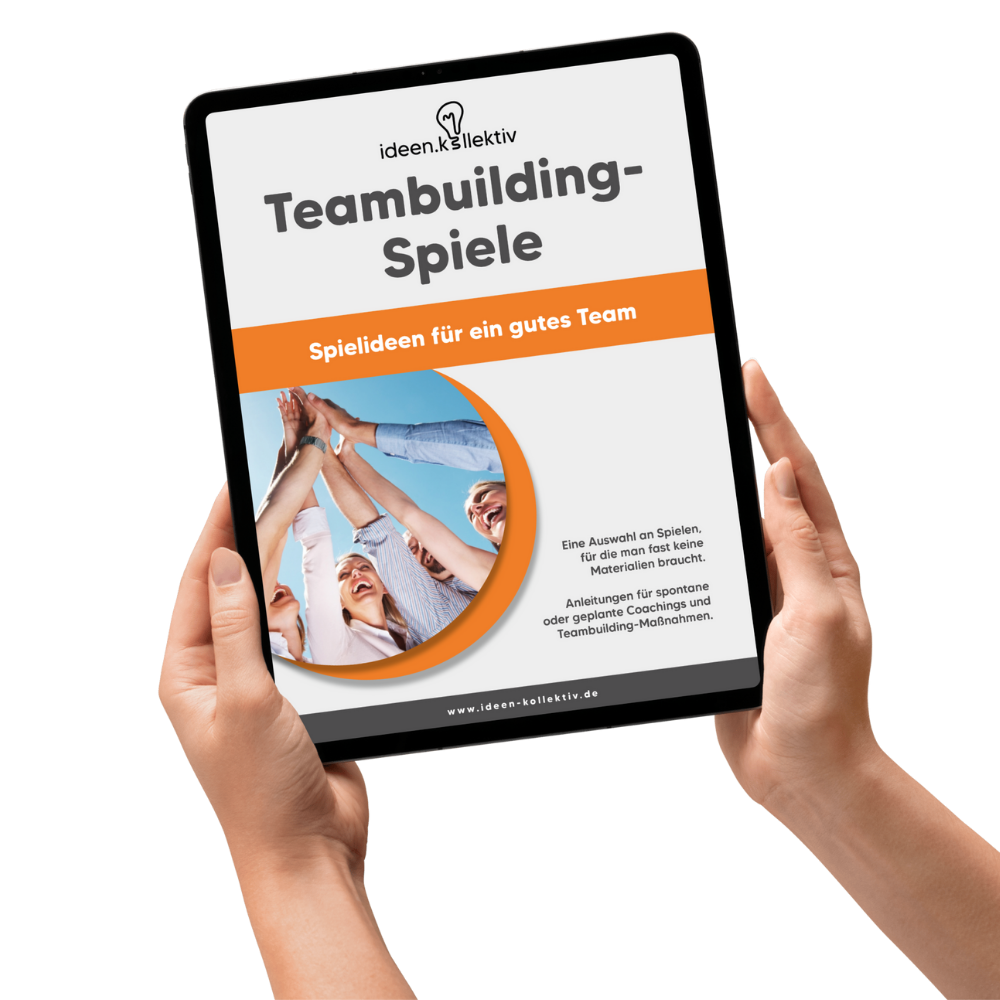
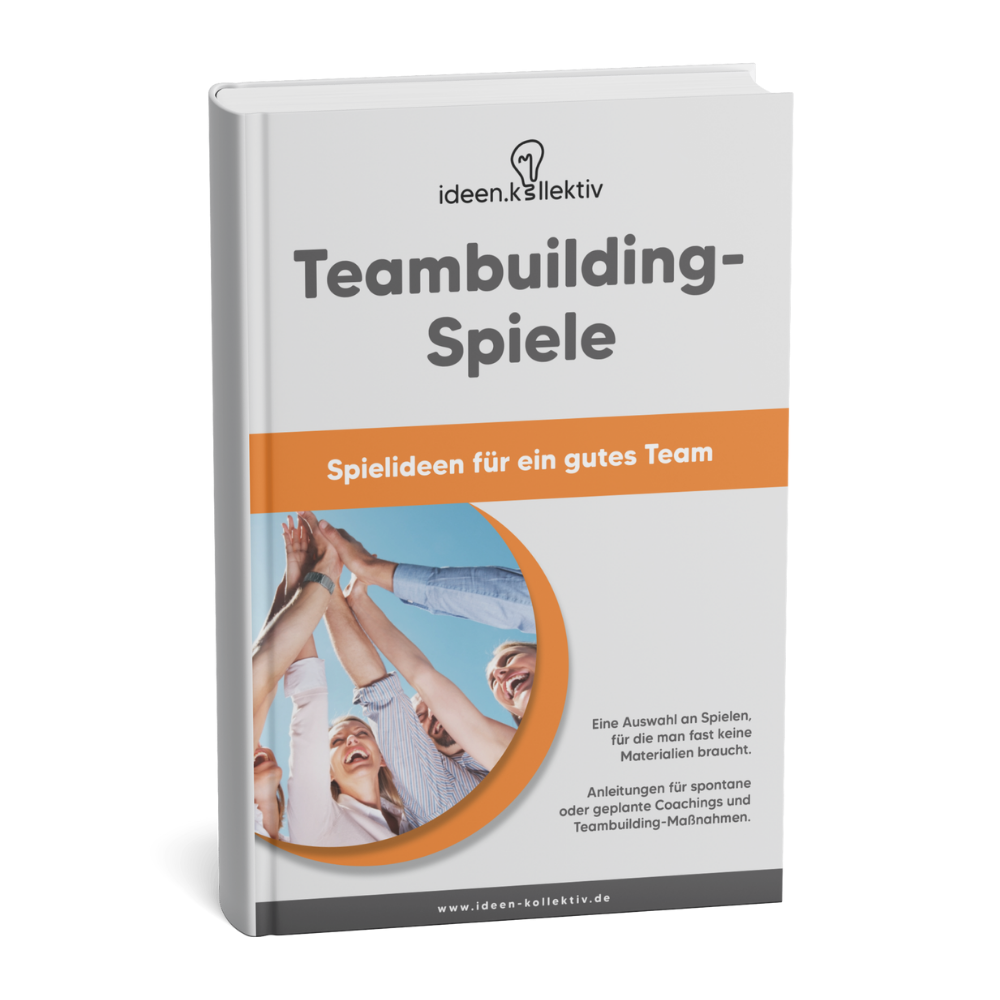
Free e-book with teambuilding games (if you want to facilitate professionally):
Quick overview: Which game for which goal?
Quick selection aid – ideal if you only have 2 minutes.
FAQ
Frequently asked questions – short, clear, practical.
How long should a teambuilding game last?
For workshops, 15–45 minutes works very well. For deep processes, 60–120 minutes. More important than length is the evaluation (5–10 minutes).
Which games are suitable for the office?
Especially good for the office: Square Up, Feel & Find, Spinning Drawer, Magic Wand, Estimation Questions, Decision Matrix, Stop/Start/Continue. Outdoor formats are great specials but not always practical.
What do I do if the team “doesn’t want games”?
Name the purpose plainly: “We are testing collaboration under time pressure” instead of “We are playing something.” Start with a format that feels professional (decision matrix, resource allocation, deep zoom).
Common mistakes (and how to avoid them)
- Game without goal → Define a one-sentence goal beforehand
- No evaluation → Schedule 5–10 minutes of reflection
- Too hard/too easy → Scale difficulty by time limit & rules